What are the Advantages of Doing Business in South Korea
South Korea Business Advantages 2026
What are the Advantages of Doing Business in South Korea
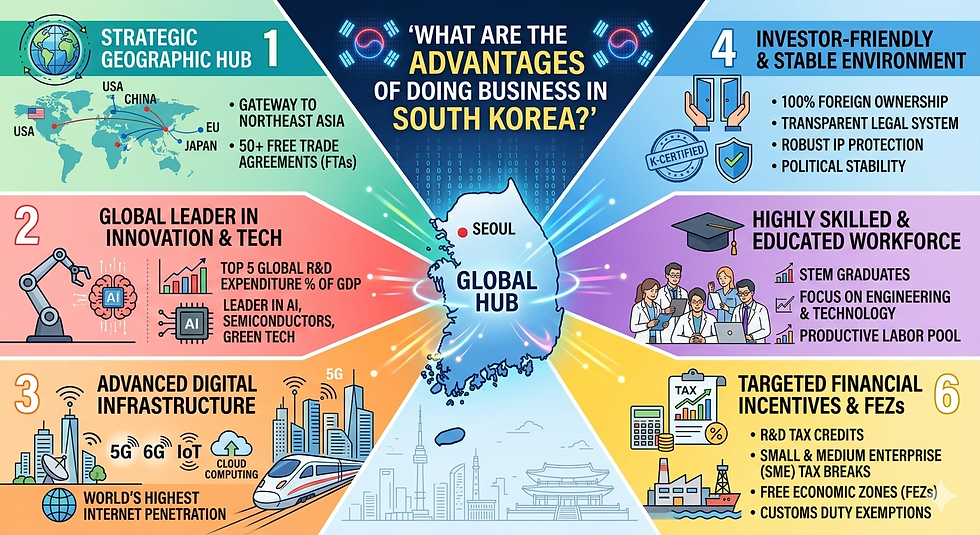
Doing business in South Korea in 2026 offers a compelling mix of high-tech innovation, strategic geography, and a supportive regulatory framework. As Asia’s fourth-largest economy, it has evolved into a global hub for semiconductors, AI, and green energy.
Here are the primary advantages:
1. Strategic Geographic Hub
South Korea serves as a "gateway" to Northeast Asia. Its proximity to major markets like China and Japan, combined with world-class logistics through Incheon International Airport and the Port of Busan, makes it an ideal regional control hub. Additionally, its extensive network of Free Trade Agreements (FTAs) significantly reduces tariff exposure for exporters.
2. Global Leadership in Innovation
Korea is no longer just a manufacturing center; it is a leader in "hard" and "soft" power.
Tech Ecosystem: It consistently ranks among the top globally for R&D expenditure as a percentage of GDP, particularly in AI, robotics, and biotechnology.
Infrastructure: It maintains some of the world's highest internet penetration rates and advanced 5G/telecommunications networks.
Cultural Export: The global "K-brand" (entertainment, content, and consumer goods) provides immediate credibility and brand power for businesses operating within the country.
3. Investor-Friendly Legal Framework
The Foreign Investment Promotion Act ensures a transparent environment for international businesses:
100% Foreign Ownership: In nearly all industries, foreign investors can establish and fully own companies without the need for a local partner.
Digital Efficiency: Procedural efficiency is high, with 2026 updates to electronic filing systems and digital tax registration making incorporation and compliance predictable.
IP Protection: South Korea maintains a robust legal framework for the protection of intellectual property rights, which is critical for tech-heavy industries.
4. Skilled Talent Pool
The workforce is highly educated, with a specific focus on STEM fields. This provides a steady supply of engineers, researchers, and technical experts ready to support high-precision industrial production and complex tech startups.
5. Targeted Tax & Financial Incentives
While general corporate tax rates have seen a slight adjustment in 2026 (ranging from 10% to 25% depending on income brackets), significant incentives remain:
R&D Credits: Substantial tax credits are available for qualifying R&D expenditures.
SME Support: Until the end of 2026, a 50% corporate income tax credit is provided for income resulting from the transfer of patents and eligible technology by Small and Medium Enterprises (SMEs).
Free Economic Zones (FEZs): These zones offer specific exemptions from acquisition and property taxes, as well as customs duty exemptions on imported capital goods for qualifying investors.
Note on 2026 Tax Changes: As of January 1, 2026, South Korea has implemented the Global Minimum Tax (Pillar Two), requiring multinational enterprises with a tax rate below 15% to pay a top-up tax. Navigating these new compliance requirements is essential for larger multinational entities.
Navigating the Future: Why Doing Business in South Korea is a Strategic Move in 2026
South Korea has solidified its position as a global epicenter for technological disruption and high-value manufacturing. For businesses looking to scale within the "Asian Growth Triangle," the Republic of Korea (ROK) offers a sophisticated landscape that rewards innovation and strategic precision.
The Strategic Advantages of the South Korean Market
Doing business in South Korea provides a unique combination of infrastructure, consumer behavior, and government support that is difficult to replicate elsewhere in the APAC region.
1. A Global Hub for Innovation and R&D
South Korea consistently ranks at the top of the Bloomberg Innovation Index. In 2026, the focus has shifted heavily toward Agentic AI, advanced semiconductors, and green energy solutions.
Infrastructure: The country boasts some of the world's fastest digital infrastructure, making it a premier testing ground for SaaS and digital transformation products.
Talent: A highly educated workforce with deep expertise in STEM ensures that companies have access to the technical skill sets required for modern industrial operations.
2. Robust Legal and IP Protections
For international firms, South Korea provides a transparent and stable regulatory environment. The Foreign Investment Promotion Act ensures that foreign-invested companies are treated with the same incentives and protections as domestic entities.
Intellectual Property: Strict enforcement of IP laws makes it a safe harbor for tech-heavy industries.
Ease of Entry: Streamlined registration processes allow for efficient company incorporation, especially for firms utilizing professional consultancy to navigate local nuances.
3. Strategic Trade Connectivity
Through its extensive network of Free Trade Agreements (FTAs), South Korea acts as a bridge between the West and the rest of Asia. Businesses operating here benefit from reduced tariffs when exporting to major markets, including the US, EU, China, and Vietnam.
How Bestar South Korea Facilitates Your Success
Expanding into a new territory requires more than just capital; it requires localized expertise and administrative excellence. Bestar South Korea provides the comprehensive support needed to bridge the gap between global ambition and local execution.
Seamless Company Incorporation
Navigating the various types of business entities—such as a Yuhan Hoesa (Limited Liability Company) or a Jusik Hoesa (Stock Company)—can be complex. Bestar simplifies this by handling the end-to-end registration process, ensuring full compliance with the Commercial Code.
Advanced Audit and Financial Advisory
In an era of "Agentic-First" professional services, Bestar utilizes AI-driven auditing tools to enhance accuracy and efficiency. This approach ensures that your financial health is monitored with precision, providing stakeholders with real-time insights and data-backed confidence.
Comprehensive Tax and Regulatory Compliance
South Korea’s tax landscape is dynamic, with specific incentives for R&D and SMEs available through 2026. Bestar’s tax consultants ensure that your business maximizes these credits while staying fully compliant with the latest Global Minimum Tax (Pillar Two) regulations.
Regional Integration
As part of a strategic network spanning Singapore, Hong Kong, and the UAE, Bestar South Korea allows businesses to maintain absolute consistency in their reporting, data entry, and professional standards across the entire Asian Growth Triangle.
Key Takeaways for 2026
Innovation: Leverage Korea's status as a leader in AI and tech.
Efficiency: Use localized partners like Bestar to navigate digital tax filing and corporate compliance.
Growth: Utilize Korea’s FTA network to access broader APAC markets.
By partnering with a firm that understands the intersection of digital transformation and traditional financial rigor, businesses can turn the complexity of the South Korean market into a distinct competitive advantage.
Ready to Expand into South Korea?
Maximize your growth potential in the Asian Growth Triangle with a partner that blends 30 years of professional rigor with 2026’s leading-edge AI technology.
From seamless company incorporation and D-8 investor visas to AI-powered auditing and regional tax optimization, Bestar South Korea ensures your transition is compliant, consistent, and competitive.
Take the Next Step
Don’t let administrative complexity slow down your innovation. Contact our regional experts today to schedule a consultation and secure your strategic foothold in Northeast Asia.
Singapore | Hong Kong | Malaysia | South Korea | UAE


댓글